- Fungi Including Lichens
- ›Basidiomycete Fungi
- ›Higher Basidiomycetes
- ›Mushrooms, Bracket Fungi, Puffballs, and Allies
- ›Shelf Fungi
- ›Phaeolaceae
- ›Phaeolus
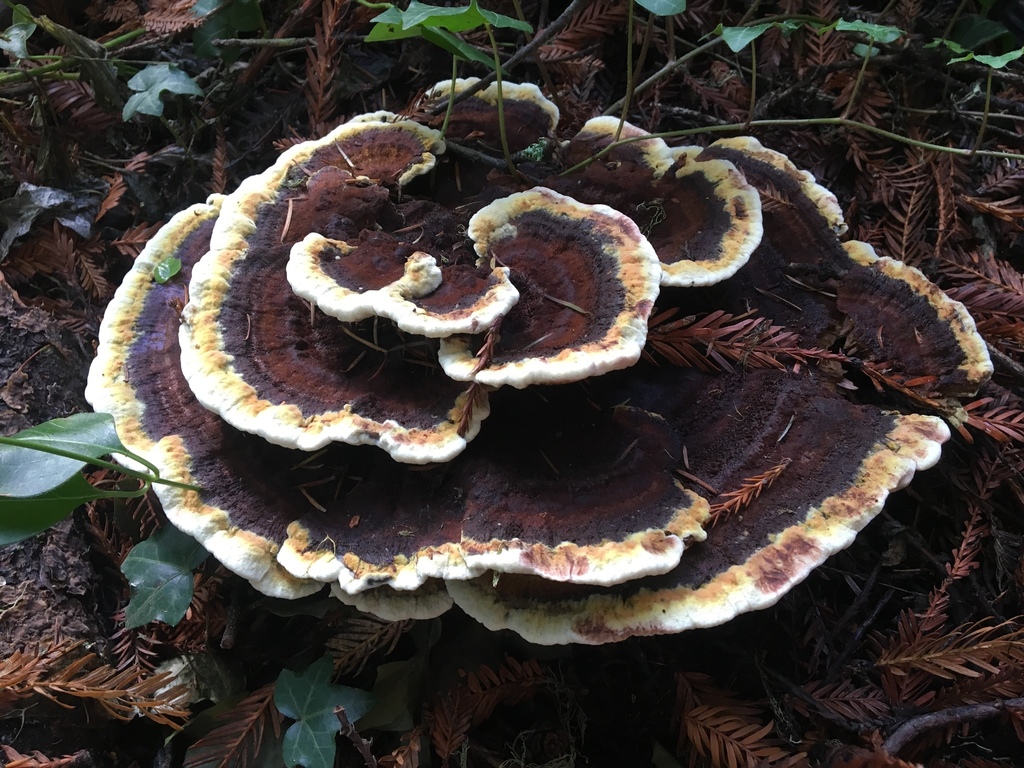
European Dyer's Polypore
Phaeolus schweinitzii
Phaeolus schweinitzii, commonly known as velvet-top fungus, dyer's polypore, or dyer's mazegill, is a fungal plant pathogen that causes butt rot on conifers such as Douglas-fir, spruce, fir, hemlock, pine, and larch. P. schweinitzii is a polypore, although unlike bracket fungi the fruiting body may appear terrestrial when growing from the roots or base of the host tree. The fruiting bodies, appearing in late summer or fall, commonly incorporate blades of grass, twigs, or fallen pine...
From the article Phaeolus schweinitzii on Wikipedia (CC BY-SA), quoted section by section
Description
P. schweinitzii is a polypore, although unlike bracket fungi the fruiting body may appear terrestrial when growing from the roots or base of the host tree. The fruiting bodies, appearing in late summer or fall, commonly incorporate blades of grass, twigs, or fallen pine needles as they grow. They are tannish with darker brown centres, with orange to pale margins on young specimens. They may grow beyond 25 centimetres (10 in) in diameter. As the fruiting bodies age, the pore surface turns from yellow to greenish yellow, the top becomes darker, and the yellow-brown flesh becomes harder and more wood-like. The pores bruise brown. The spores are white, elliptical, smooth, and inamyloid. The effect, impact and significance of infection by this fungus is rooted in the fact that it causes brown rot, which degrades the cellulose. Thus there is a loss of tensile strength which often leads to brittle fracture near the stem base, even at a fairly early stage of decay. Decay initiated above ground can lead to branch snap or breakout.
Similar species. Similar species include Heterobasidion irregulare, H. occidentale, Inonotus dryophilus, and Onnia tomentosa.
Range & habitat
P. schweinitzii causes butt rot on conifers such as Douglas-fir, spruce, fir, hemlock, pine, and larch. It is native to Eurasia, and has been identified as an exotic species in New Zealand, Australia, and South Africa.
Wikipedia: “Habitat and distribution”
At the table
As its common name suggests, the dyer's polypore is an excellent natural source of green, yellow, gold, or brown dye, depending on the material dyed and the mordant used. The species is not edible.
== References ==
Wikipedia: “Uses”
Where it lives
Recorded sightings
—
geo-referenced records in GBIF, from museums, herbaria and field observers.
Drag the globe to turn it. Dots are where records exist, not a range map; darker means more records.
In the stacks
Searching the stacks…
Every page naming Phaeolus schweinitzii in the Biodiversity Heritage Library →
This page is assembled live from iNaturalist, GBIF, Wikipedia, the Source Library and the Internet Archive. It is not yet part of the hand-edited codex. iNaturalist taxon 118084.