- Fungi Including Lichens
- ›Basidiomycete Fungi
- ›Higher Basidiomycetes
- ›Tremellomycetes
- ›Tremellales
- ›Bulleraceae
- ›Pseudotremella
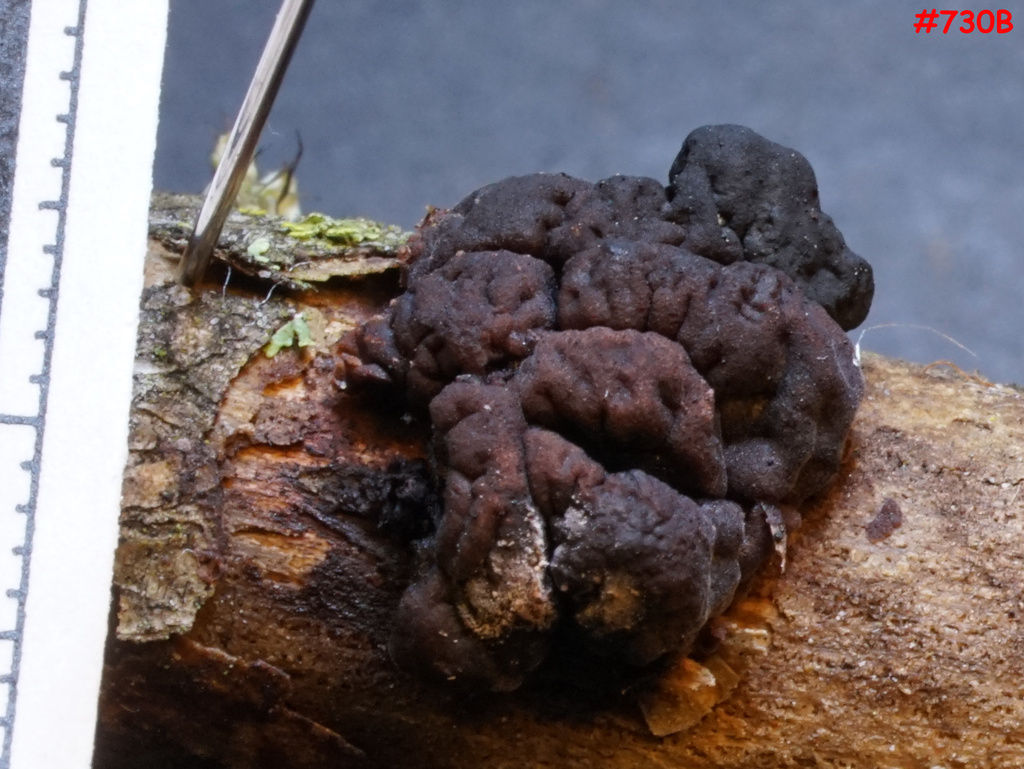
mulberry brain
Pseudotremella moriformis
Pseudotremella moriformis is a species of fungus in the family Bulleraceae. It produces dark purple, pustular, gelatinous basidiocarps (fruit bodies) and is parasitic on pyrenomycetous fungi (Diaporthe species) on dead herbaceous stems and wood. It was originally described from England.
From the article Pseudotremella moriformis on Wikipedia (CC BY-SA), quoted section by section
Description
Fruit bodies are gelatinous, dark purple-black, pustular, up to 0.5 cm across, but sometimes becoming larger (up to 1.5 cm across) and cerebriform (brain-like) through confluence. They emerge from the perithecia of their host. Microscopically, the basidia are tremelloid (globose to ellipsoid, with vertical or oblique septa), 2 to 4-celled, 15 to 22 by 14 to 20 μm. The basidiospores are subglobose, smooth, 8 to 9 by 8.5 to 10 μm.
Range & habitat
Pseudotremella moriformis is a parasite on Diaporthe species and possibly other ascomycetous hosts. It is found on dead, attached or fallen wood of deciduous trees. The species was described from England and has been reported elsewhere in the United Kingdom and from continental Europe in Belgium, France, Germany, Italy, Poland, Portugal, and Spain. Outside Europe, the species has also been reported from Canada, the US, and Brazil.
== References ==
Wikipedia: “Habitat and distribution”
In human culture
As Tremella moriformis, the species was originally described from Surrey in 1812 by English naturalists James Edward Smith and James Sowerby. It remained in Tremella until 2015 when molecular research, based on cladistic analysis of DNA sequences, showed that it was only distantly related to this genus and belonged instead to the newly proposed Pseudotremella in the family Bulleraceae. Tremella atroglobosa, described from Brazil, and T. colorata, described from the US, are widely considered synonyms of T. moriformis. The Latin epithet "moriformis" means "mulberry-shaped", with reference to both the shape and colour of typical fruit bodies.
Wikipedia: “Taxonomy and etymology”
Where it lives
Recorded sightings
—
geo-referenced records in GBIF, from museums, herbaria and field observers.
Drag the globe to turn it. Dots are where records exist, not a range map; darker means more records.
In the stacks
Searching the stacks…
Every page naming Pseudotremella moriformis in the Biodiversity Heritage Library →
This page is assembled live from iNaturalist, GBIF, Wikipedia, the Source Library and the Internet Archive. It is not yet part of the hand-edited codex. iNaturalist taxon 1110067.