- Fungi Including Lichens
- ›Basidiomycete Fungi
- ›Higher Basidiomycetes
- ›Mushrooms, Bracket Fungi, Puffballs, and Allies
- ›Shelf Fungi
- ›Bracket Polypores
- ›Fomitopsis
- ›Fomitopsis pinicola
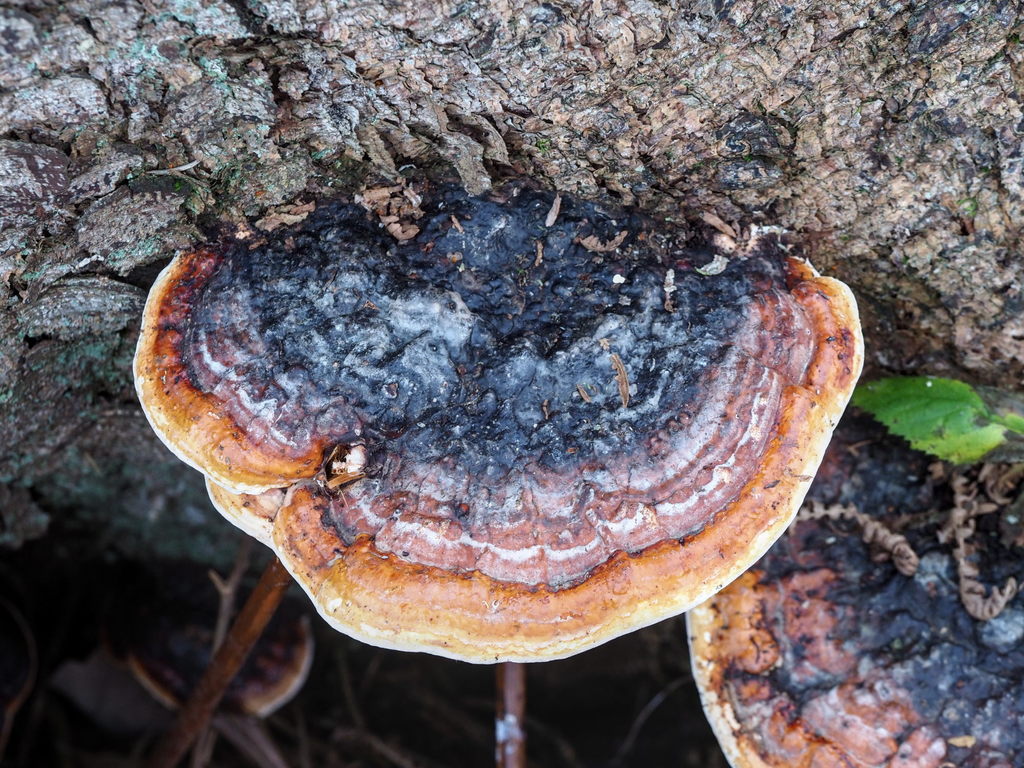
Red-banded Polypore
Fomitopsis pinicola
Fomitopsis pinicola, is a stem-decay fungus. Its conk (fruit body) is known as the red-belted conk or red-belted bracket. The species is common throughout temperate Eurasia. It is a decay fungus that serves as a small-scale disturbance agent in coastal rainforest ecosystems. It influences stand structure and succession in temperate rainforests. It performs essential nutrient cycling functions in forests. It is also a key producer of brown rot residues that are stable soil components in coniferous forest ecosystems.
From the article Fomitopsis pinicola on Wikipedia (CC BY-SA), quoted section by section
Description
The cap is hoof-shaped or triangular, and sometimes shelflike. It is hard and tough, and up to 30 cm or more across and 15 cm thick. Its surface is more or less smooth, at first orange-yellow with a white margin, later dark reddish to brown and then frequently with an orange margin. The pore surface is pale yellow to leather-brown, 3–4 pores per mm. It grows as thick shelves on live and dead coniferous or (less commonly) deciduous trees. The spores are pale yellow and smooth. The species also grows as a layer of tubes on the bottom of fallen wood. The fruiting body of F. pinicola is called the conk. It is a woody, pileate fruiting body with pores lined with basidia on its underside. As in other polypores, the fruiting body is perennial with a new layer of pores produced each year on the bottom of the old pores. The pores are whitish when young and become somewhat brownish in age.
Similar species. Similar species include Ganoderma lucidum, Laricifomes officinalis, and Heterobasidion annosum.
Range & habitat
The species is common throughout temperate Eurasia. It is common on softwood and hardwood trees. This stem decay fungus is found on live conifer trees in southeast Alaska such as Western hemlock, Mountain hemlock, White spruce, Lutz spruce and Sitka spruce. The tree stem decay is caused by the fungus when it invades and colonizes the wood of living trees and decomposes the wood before the tree is dead. This brown rot fungus degrades only cellulose, leaving the other primary constituents of wood, lignin, as a considerably less dense but fairly stable residual structure that is suitable for excavation by woodpeckers. This fungus is normally found on dead pines, but can be found on all conifers. It can also be observed growing on large stem wounds, broken tops, and dead tissue of live trees. In mature forests, these stem decay fungi cause enormous annual wood volume loss of Alaska's major tree species. Approximately one-third of the old-growth timber board-foot volume in Southeast Alaska is defective, largely due to decay from this type of fungus. Conversely, there is very little decay in young-growth stands without prevalent wounding from commercial thinning activities, wind damage, or animal feeding. …
Wikipedia: “Distribution, habitat and ecology”
At the table
This mushroom is inedible due to its woody texture, but it is useful as tinder. It can potentially be prepared as a famine food through a laborious process. The basidiocarps of the fungus have been reported to have medicinal uses in Asia. It has been reported that mushrooms have significant antioxidant activity.
Wikipedia: “Potential uses”
Where it lives
Recorded sightings
—
geo-referenced records in GBIF, from museums, herbaria and field observers.
Drag the globe to turn it. Dots are where records exist, not a range map; darker means more records.
In the stacks
Searching the stacks…
Every page naming Fomitopsis pinicola in the Biodiversity Heritage Library →
This page is assembled live from iNaturalist, GBIF, Wikipedia, the Source Library and the Internet Archive. It is not yet part of the hand-edited codex. iNaturalist taxon 1098280.