- Fungi Including Lichens
- ›Ascomycete Fungi
- ›Sac Fungi and Lichens
- ›Sordariomycetes
- ›Diaporthomycetidae
- ›Magnaporthales
- ›Pyriculariaceae
- ›Pyricularia
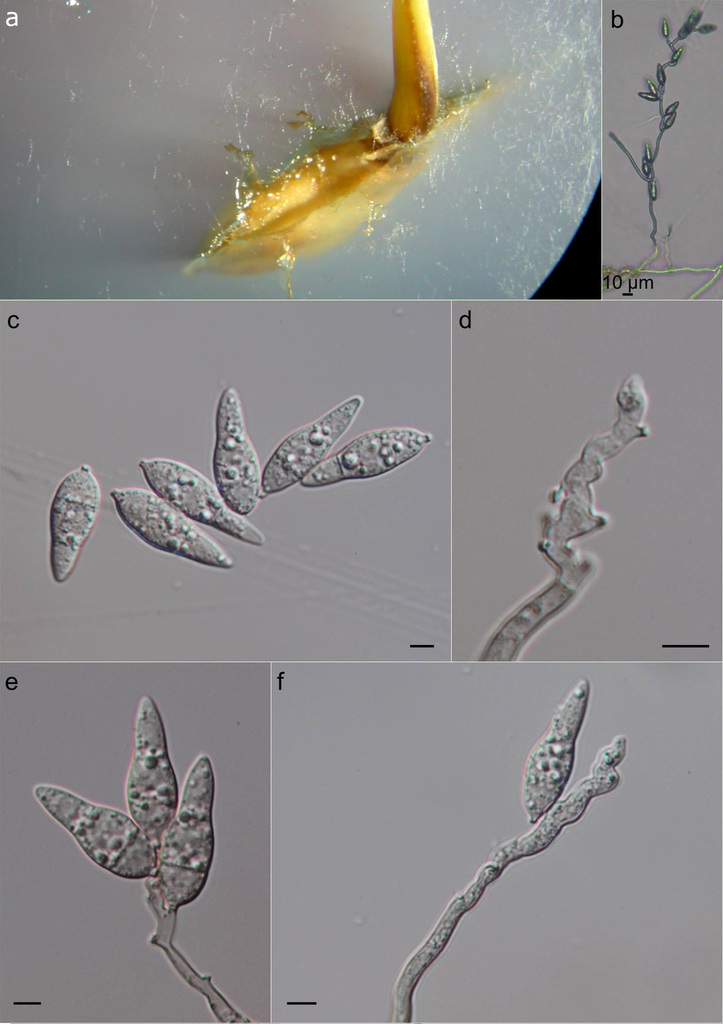
Pyricularia oryzae
Magnaporthe grisea, also known as rice blast fungus, rice rotten neck, rice seedling blight, blast of rice, oval leaf spot of graminea, pitting disease, ryegrass blast, Johnson spot, neck blast, wheat blast and Imochi (稲熱), is a plant-pathogenic fungus and model organism that causes a serious disease affecting rice. It is now known that M. grisea consists of a cryptic species complex containing at least two biological species that have clear genetic differences and do not interbreed. Complex members isolated from Digitaria have been more narrowly defined as M. grisea. The remaining members of the complex isolated from rice and a variety of other hosts have been renamed Magnaporthe oryzae, within the same M. grisea complex. Confusion on which of these two names to use for the rice blast pathogen remains, as both are now used by different authors.
Members of the M. grisea complex can also infect other agriculturally important cereals including wheat, rye, barley, and pearl millet causing diseases called blast disease or blight disease. Rice blast causes economically significant crop losses annually. Each year it is estimated to destroy enough rice to feed more than 60 million people. The fungus is known to occur in 85 countries worldwide and as of 2003 was the most devastating fungal plant pathogen in the world.
From the article Magnaporthe grisea on Wikipedia (CC BY-SA), quoted section by section
Range & habitat
Wheat blast was found in the 2017–2018 rainy season in Zambia, in the Mpika district of the Muchinga Province. In February 2016 a devastating wheat epidemic struck Bangladesh. Transcriptome analysis showed this to be an M. grisea lineage most likely from Minas Gerais, São Paulo, Brasília, and Goiás states of Brazil and not from any geographically proximate strains. This successful diagnosis shows the ability of genetic surveillance to untangle the novel biosecurity implications of transcontinental transportation and allows the Brazilian experience to be rapidly applied to the Bangladeshi situation. To that end the government has set up an early warning system to track its spread through the country.
Wikipedia: “Geographical distribution”
What it does
A 2010 review reported clones for quantitative disease resistance in plants. The rice plant responds to the blast pathogen by releasing jasmonic acid, which cascades into the activation of further downstream metabolic pathways which produce the defense response. This accumulates as methyl-jasmonic acid. The pathogen responds by synthesizing an oxidizing enzyme which prevents this accumulation and its resulting alarm signal. OsPii-2 is a rice protein that acts as an immunoreceptor. It binds to the rice's own Exo70-F3 protein. This protein is a target of the M. oryzae effector AVR-Pii that the fungus secretes during infection. Thus, this allows the OsPii-2 protein to monitor for M. oryzae's attack against that target. Some rice cultivars carry resistance alleles of the OsSWEET13 gene, which produces the molecular target of the X. oryzae pv. oryzae effector PthXo2.
Wikipedia: “Biochemistry of host-pathogen interactions”
Where it lives
Recorded sightings
—
geo-referenced records in GBIF, from museums, herbaria and field observers.
Drag the globe to turn it. Dots are where records exist, not a range map; darker means more records.
In the stacks
Searching the stacks…
Every page naming Pyricularia oryzae in the Biodiversity Heritage Library →
This page is assembled live from iNaturalist, GBIF, Wikipedia, the Source Library and the Internet Archive. It is not yet part of the hand-edited codex. iNaturalist taxon 1095657.