- kingdomAnimalia
- ›phylumChordata
- ›classElasmobranchii
- ›orderSquatiniformes
- ›familySquatinidae
- ›genusSquatina
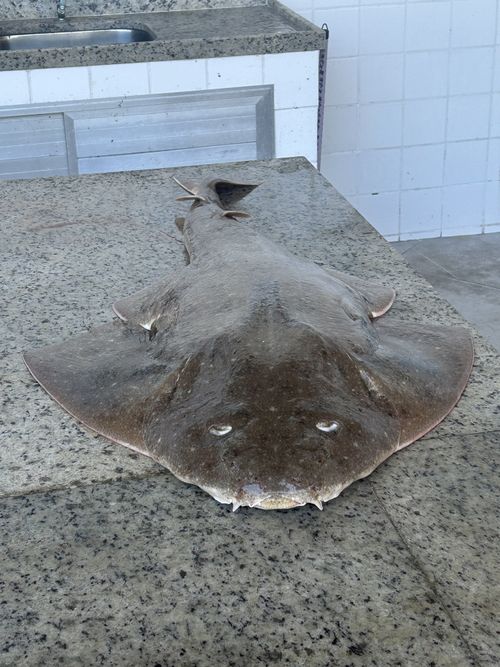
Images attached to GBIF records (field photographs), from . Open licences; click for the record.
Hidden Angelshark
Squatina occulta Vooren & da Silva, 1992
Also calledSqualo angelo nascosto (ita) · polorejnok brazilský (ces)
First described in: Vooren, C. M.; da Silva, K. G. (1992). On the taxonomy of the angel sharks from southern Brazil, with the description of Squatina occulta sp. n. <em>Revista Brasileira de Biologia.</em> 51 (3) [1991]: 589-602.
Descriptions from checklists and floras indexed by GBIF
description
Description. Measurements are presented in Table 1; meristic data in Table 2. The following description is based on all specimens (Figs. 1 to 10). External morphology. Body markedly depressed dorsoventrally from head to origin of caudal fin (head height 5.4 to 9.8 % TL). Pectoral-pelvic distance 7.7 to 12.3 % TL, width at pectoral origins 12.5 to 17.9 % TL, and trunk width 13 to 22.9 % TL. Head broad, anterior margin rounded to trapezoidal, and posterior margin straight to concave, projecting obliquely to medial side (Fig. 5 a). Dermal folds extend along entire lateral margin of head, from distal end of ventral labial furrow to superior margin of first gill opening. Dermal fold margins straight to slightly convex in some specimens, without lobes or projections (Fig. 53 d). Snout very short. Shape of anterior margin between nostrils slightly convex, straight or concave, with dorsal surface straight to slightly convex. Preorbital length 2.5 to 5.5 % TL, without preorbital pit. Eyes small, not greatly protruding above head, elliptical and slightly obliquely positioned (preocular distance 4.6 to 6.4 % TL, eye length 1.6 to 3.1 % TL and width 0.9 to 1.9 % TL). Eyes widely separated, int
Morphological and taxonomic revision of species of Squatina from the Southwestern Atlantic Ocean (Chondrichthyes: Squatiniformes: Squatinidae)
description
Squatina argentina: Bigelow and Schroeder, 1948: 544 – 546, figs. 103 d, 106 (taxonomic revision); Roux, 1977: 159 – 168, fig. 8 and pl. 4 (taxonomic revision, in part, only MNHN 1989.133); Roux, 1979: 124 – 125, fig. 10 (taxonomic account, in part, only MNHN 1989.133) Solé-Cava et al., 1983: 355 – 358 (isozymic studies, cited as " morphotype II "); Compagno, 1984: 139, 142 (taxonomic account, figured); Solé-Cava and Levy, 1987: 139 – 144 (isozymic studies, cited as " morphotype II "). Squatina dumeril: Nunan and Senna, 2007: 174 (misidentification, in part, only MNRJ 30191). Squatina guggenheim: Soto, 2001: 97 (misidentification, listed); Soto and Mincarone, 2004: 83 – 84 (misidentification, listed); Bernardes et al., 2005: 73 (misidentification, taxonomic account, figured); Compagno et al., 2005: 142 – 143, pl. 18 (misidentification, identification guide). Squatina squatina:? Schreiner and Miranda Ribeiro, 1903: 80 (taxonomic account);? Miranda Ribeiro, 1907: 169 – 171, fig. 10 (taxonomic account).
Morphological and taxonomic revision of species of Squatina from the Southwestern Atlantic Ocean (Chondrichthyes: Squatiniformes: Squatinidae)
diagnosis
Diagnosis. A species of Squatina diagnosed by its unique dorsal color pattern, composed of a uniform light to dark brown background color, with numerous white to yellowish rounded, small spots on entire dorsal surface, some surrounded by many small black spots, forming irregular ocelli-like markings. Squatina occulta is further distinguished from S. guggenheim by presenting smaller and more numerous white spots on entire dorsal surface (spot size one-half to eye-length vs. less numerous spots about equal to eye to 1.5 eye-length in S. guggenheim); larger size at maturity (greater than 1000 mm vs. from 730 to 800 mm in S. guggenheim); dermal denticles over pectoral fins morphologically homogeneous, without any sort of enlarged dermal denticle present (vs. a pair or more of enlarged dermal denticles close to dorsal pectoral origin in Squatina guggenheim); dorsal midline with denticles morphologically similar to trunk denticles, or denticles over dorsal midline posterior to pectoral insertion slightly enlarged (basal plate 1.5 – 2 times diameter of other dorsal denticles) and organized in a row in some juveniles of S. occulta (S. guggenheim with row of enlarged, conical denticles over
Morphological and taxonomic revision of species of Squatina from the Southwestern Atlantic Ocean (Chondrichthyes: Squatiniformes: Squatinidae)
discussion
Remarks. The holotype could not be studied, but both paratypes were examined. Although fresh specimens were not directly examined, photographs of fresh specimens allowed us to confirm that there are no significant differences in color compared to preserved specimens, only that the background color is generally brighter. Apparently, as in S. guggenheim (described below), the mucous is pigmented exactly over the larger whitish spots (Fig. 2 c). Accordingly, characters from dorsal coloration are useful to diagnose Southwestern Atlantic Squatina (see diagnosis).
Morphological and taxonomic revision of species of Squatina from the Southwestern Atlantic Ocean (Chondrichthyes: Squatiniformes: Squatinidae)
Where it has been recorded
Recorded sightings
—
geo-referenced records in GBIF, from museums, herbaria and field observers.
Drag the globe to turn it. Dots are where records exist, not a range map; darker means more records.
In the stacks
Searching the stacks…
Every page naming Squatina occulta in the Biodiversity Heritage Library →
From the GBIF Backbone Taxonomy and occurrence records (GBIF.org), with Wikipedia and the Source Library. GBIF species 2417780.