

Bodianus parrae
Bodianus parrae (Bloch & Schneider, 1801)
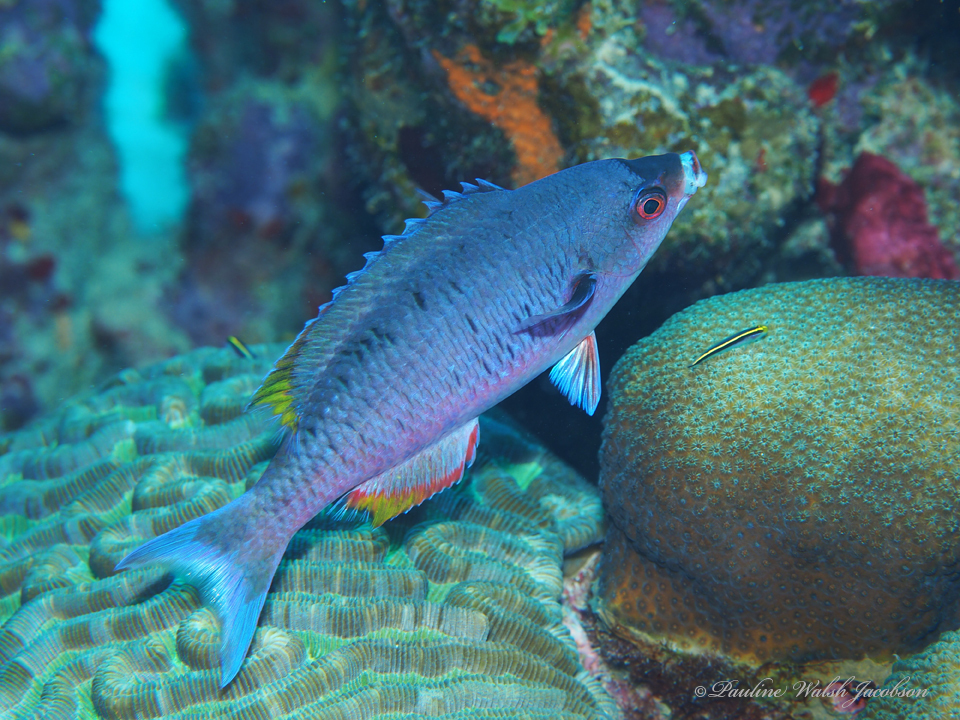
The creole wrasse (Bodianus parrae) is a species of wrasse native to the western Atlantic Ocean.
- Also published as
- Brama parrae Bloch & Schneider, 1801; Clepticus parrae (Bloch & Schneider, 1801); Clepticus parrai (Bloch & Schneider, 1801); Clepticus genizara Cuvier, 1829
From Wikipedia (CC BY-SA), quoted section by section
Description
The creole wrasse is a small wrasse, with males reaching around 30 cm (1 ft) in length, while females are smaller. It has a typical wrasse shape. Like many wrasse, it changes colour markedly during its lifetime, with juveniles being almost completely violet-purple. As it matures, it develops a yellow patch on the rear part of its body.
Range & habitat
The species is found throughout the tropical waters of the western Atlantic Ocean from Florida to Brazil, including Bermuda Islands, the Caribbean Sea, and the Gulf of Mexico.
What it does
This wrasse lives in groups, aggregating on coral reef slopes, down to around 100 m (330 ft) in depth. These groups feed on plankton, including small jellyfish, pteropods, pelagic tunicates, and invertebrate larvae. The creole wrasse is active by day, and at night it retreats alone to a rocky crevice in the reef to sleep.
Where it has been recorded
Recorded sightings
—
geo-referenced records in GBIF, from museums, herbaria and field observers.
Drag the globe to turn it. Dots are where records exist, not a range map; darker means more records.
In the stacks
Searching the stacks…
Every page naming Bodianus parrae in the Biodiversity Heritage Library →
References
- Bloch, M. E., & Schneider, J. G. (1801). M.E. Blochii, Systema Ichthyologiae iconibus cx illustratum. Post obitum auctoris opus inchoatum absolvit, correxit, interpolavit Jo. Gottlob Schneider, Saxo. Berolini. Sumtibus Auctoris Impressum et Bibliopolio Sanderiano Commissum, Pp i–lx + 1–584, Pls. 1–110. https://doi.org/10.5962/bhl.title.5750
- Cuvier, G. (1829). Le Règne Animal distribué, d’apres son organisation, pour servir de base à l’histoire naturelle des animaux et d’introduction à l’anatomie comparée. [The Animal Kingdom, arranged according to its organization, to serve as a basis for the natural history of animals and as an introduction to comparative anatomy]. Déterville, Paris, Edition 2. v. 2: i–xv + 1–406. https://doi.org/10.5962/bhl.title.1964
From the Catalogue of Life (catalogueoflife.org), compiled from its specialist databases; CC BY 4.0. This name in the Catalogue of Life.